
I helped Niche expand beyond lead generation by turning enrollment research into a product strategy, phased roadmap, and connected platform that helps institutions engage students throughout the enrollment journey.
ROLE
Staff Product Designer, Design Lead
TIMELINE
11 months · October 2025–August 2026
SCOPE
Product strategy · Generative research · Concept testing · Roadmap definition · Interaction design · Cross-team design leadership
OVERVIEW
From generating leads to helping institutions enroll students
Niche had established a strong position in student lead generation, but enrollment teams faced broader challenges: limited resources, fragmented systems, and increasing pressure to improve enrollment outcomes.
Leadership saw an opportunity to expand beyond lead generation, but the product strategy, market entry point, and scope were still undefined.
As design lead, I helped turn that ambition into a phased product strategy and a unified enrollment platform. I led generative research with higher education institutions, tested early product concepts, and translated findings into opportunities that informed our roadmap. Partnering with Product and Engineering leadership, I helped prioritize where to enter the market and guided design across two teams to bring that strategy to life.
We launched with automated enrollment campaigns to validate demand, then introduced CRM connectivity to support more personalized outreach, student engagement, and performance measurement. This phased approach laid the foundation for Advance 2.0, evolving Niche from a lead generation provider toward a more connected enrollment partner.
THE CHALLENGE
Moving beyond lead generation without becoming another CRM
Higher education enrollment teams already relied on complex technology ecosystems. CRMs managed student records, communications, and recruitment workflows. Reporting tools tracked performance. Counselors coordinated outreach across multiple channels.
Introducing another product wasn't inherently valuable.
For Niche to expand its role in the enrollment process, we needed to understand where institutions were underserved and identify opportunities that complemented their existing systems rather than duplicated them.
Three questions shaped our work:
Where were enrollment teams struggling? Understand the operational and strategic challenges institutions faced throughout the enrollment journey.
Where could Niche differentiate? Identify capabilities that offered value beyond what existing CRMs and communication platforms provided.
What should we build first? Balance a longer-term product ambition with the need to validate demand and deliver value incrementally.
The challenge wasn't simply designing a better campaign tool. It was identifying a credible path into a broader enrollment problem space.
UNDERSTANDING THE MARKET
Research revealed that institutions needed more than another tool
Before the first automated campaigns shipped, I led generative research and concept testing at NACAC to better understand the challenges enrollment teams faced and evaluate potential solutions.
Across the research, six recurring challenges emerged.
Operational inefficiency
Enrollment teams spent significant time managing repetitive communications and manual follow-up. Limited staffing made it difficult to provide consistent support throughout the student journey.
Fragmented experiences
Institutions were already navigating multiple systems. Partners questioned whether introducing another platform would improve their workflows or create additional complexity.
Lack of actionable guidance
Teams had access to performance data but struggled to determine what actions to take. Participants wanted recommendations and diagnostic insights rather than additional reports.
Limited differentiation
Many proposed capabilities, including segmentation and campaign management, were already available in institutional CRMs. Partners questioned what Niche could offer that was meaningfully different.
Trust and control
Automation raised concerns about message accuracy, institutional voice, audience governance, and unintended communication. Partners wanted efficiency without losing oversight.
Personalization at scale
Institutions wanted communications that built relationships with students, but lacked the capacity to personalize every interaction manually.
The opportunity was becoming clearer
These findings challenged the idea that more automation or more functionality would automatically create value.
Institutions needed help reducing operational work, making better decisions, and communicating with students in ways that felt authentic.
Niche had an opportunity to connect its student intelligence with the systems and workflows institutions already used—helping enrollment teams act on opportunities rather than simply manage more tools.
FINDING THE OPPORTUNITY
Testing concepts exposed where Niche could win
We evaluated four concepts with enrollment professionals to understand which opportunities resonated, where they overlapped with existing tools, and what conditions would influence adoption.
Out-of-the-Box Campaigns
Make enrollment outreach easier to launch and manage.
Partners responded positively to ready-made campaigns supporting important enrollment actions, including scheduling visits, understanding costs, and connecting with counselors.
The concept performed strongly across most tested areas, with positive signals from 3–4 of 4 participants.
But institutions were clear that convenience couldn't come at the expense of authenticity. Messages needed to reflect their voice, use accurate data, and fit existing communication strategies.
What we learned: Prebuilt automation offered an accessible starting point, but control and personalization would become increasingly important as the product matured.
Reporting Insights
Move from reporting performance to guiding decisions.
Reporting concepts received strong feedback, scoring 14–15 of 15 across the tested dimensions.
Partners appreciated familiar, understandable reporting but wanted more than campaign metrics. They were interested in benchmarks, diagnostic insights, and recommendations that could help improve enrollment outcomes.
They also wanted transparency into the underlying data and methodology.
What we learned: Reporting could become a differentiator when it connected Niche's contribution to meaningful enrollment outcomes and helped institutions decide what to do next.
Suggested Audiences
Go beyond the segmentation capabilities institutions already have.
Suggested audiences presented prebuilt student groups aligned with common enrollment milestones.
While transactional audiences resonated strongly—9 of 9 participants recognized their usefulness—only 5 of 9 saw novelty in the concept.
Many institutions already managed similar groups through their CRMs.
The more compelling opportunity was dynamic targeting informed by student behavior, engagement, and signals that institutions couldn't easily generate themselves.
What we learned: Niche needed to enrich existing workflows with differentiated intelligence, not reproduce standard CRM functionality.
The insight that shaped our direction
The concept testing revealed a consistent tension.
Institutions were interested in automation, targeting, and reporting, but they were skeptical of adding another platform that performed familiar tasks.
The strongest opportunity was to combine operational simplicity with differentiated student intelligence, while giving institutions the control needed to trust the system.
This became an important lens for shaping the roadmap.
DEFINING THE PRODUCT STRATEGY
We prioritized learning before flexibility
Following the research, I worked directly with the pod's Director of Product and Director of Engineering to help define the roadmap.
I then partnered with Product Managers and Engineering Managers across two teams to refine priorities and translate the broader direction into actionable work.
Rather than attempting to deliver a comprehensive enrollment platform immediately, we took a phased approach.
First, validate the appetite for automation
Our initial priority was to launch automated campaigns running on Niche.
We deliberately limited the experience: campaigns were predefined, with no personalization or full customization.
This was a consequential tradeoff.
The research showed that institutions valued personalization and control. But building those capabilities from the start would have increased complexity before we had validated demand for the core offering.
By prioritizing simplicity, we could introduce the value of automated outreach without first building a fully configurable campaign platform.
The decision was to validate the fundamental opportunity before investing in its most sophisticated capabilities.
Next, establish the foundation for differentiation
Once the initial campaign offering was established, CRM integration became the next major priority.
Two-way data sharing between Niche and institutional systems was essential to expanding what the product could do.
It created the foundation for more relevant student communications, greater personalization, and attribution that connected outreach activity to enrollment outcomes.
This was more than a technical integration. It was a strategic dependency.
Without connected data, Advance would remain limited in its ability to deliver the intelligence and relevance institutions had asked for.
A roadmap built around progressive value
The sequence reflected three deliberate priorities:
Validate the opportunity. Start with a focused offering that reduced operational work.
Build the foundation. Connect institutional and Niche data to enable more sophisticated capabilities.
Expand the experience. Introduce personalization, control, and broader campaign coverage as the product evolved.
Rather than treating the roadmap as a collection of features, we used it to progressively reduce uncertainty and unlock new value.
BRINGING ADVANCE TO LIFE
Designing for a connected enrollment experience
As the product evolved, the design challenge expanded beyond individual campaigns.
We needed to create an experience that could support different levels of institutional sophistication, connect with existing workflows, and make increasingly complex capabilities understandable and manageable.
Several areas became central to the work.
Making automation approachable
The initial campaign experience prioritized simplicity.
Instead of asking institutions to build complex communication workflows from scratch, predefined campaigns provided a more accessible way to begin using automation.
This lowered the complexity of the initial offering while allowing us to learn whether institutions saw value in the product.
As Advance evolved, the experience needed to accommodate more flexibility without losing that approachable starting point.
Balancing personalization with institutional control
Research consistently reinforced that institutions wanted to maintain ownership of their communications.
Message accuracy, brand voice, and human oversight were essential to trust.
As personalization capabilities expanded, the design needed to make greater control possible while preserving the efficiency that made automation valuable in the first place.
The challenge was not simply providing more settings. It was balancing automation with the institution's responsibility for the student relationship.
Connecting systems rather than creating another silo
CRM integration represented an important shift in the product's capabilities.
Two-way data sharing allowed Advance to move beyond standalone outreach and begin incorporating institutional data into more relevant communication and attribution experiences.
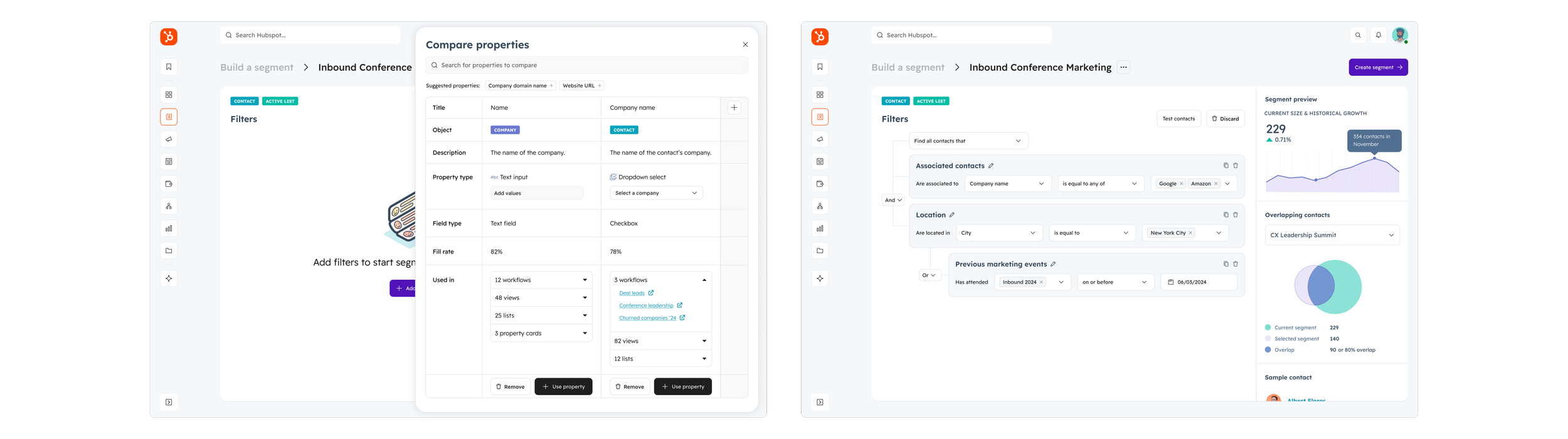
From a design perspective, this introduced new considerations around connected data, configuration, and communicating how information moved between systems.
The goal was to make Niche more useful within an institution's existing ecosystem rather than requiring partners to abandon established workflows.
Supporting more of the student journey
The initial campaign offering focused on a limited set of enrollment actions.
Advance 2.0 expanded that coverage with additional campaigns, suggested campaigns, and multi-touch communication.
This required the experience to support a broader range of student needs and communication strategies while remaining understandable to enrollment teams.
What began as a focused automation offering was evolving into a product that could support more moments across the enrollment lifecycle.
Leading design across two teams
As the scope grew, so did the need for coordination.
My role involved working across two teams within the pod, partnering with Product and Engineering leadership to connect the broader strategy to implementation.
This meant contributing to roadmap decisions at the leadership level while helping teams refine scope, evaluate experience tradeoffs, and maintain coherence as capabilities expanded.
The design work wasn't confined to individual interfaces. It involved helping shape how the product evolved as a connected experience.
IMPACT & REFLECTION
From a strategic ambition to a shipped product
The most important outcome was establishing a credible path from Niche's full-funnel ambition to a progressively more capable enrollment product.
Before the initial campaign launch, research helped clarify the needs, opportunities, and adoption barriers in a market where institutions already had established technology and workflows.
That evidence informed a phased roadmap that began with simple automation, prioritized CRM connectivity, and expanded into more sophisticated campaign and personalization capabilities.
By the Advance 2.0 release, we had shipped a broader campaign offering with message control, personalization, suggested campaigns, and multi-touch communication.
The work helped Niche extend its product offering beyond lead generation and further into the enrollment journey.
What changed
A clearer product direction. Generative research and concept testing helped identify where Niche could create differentiated value and where existing CRM capabilities created adoption challenges.
A phased approach to investment. We deliberately traded early customization for simplicity, then prioritized the data infrastructure needed to unlock personalization and attribution.
A more capable product. Advance evolved from predefined automated campaigns into an offering supporting more enrollment moments and more sophisticated communication workflows.
Cross-functional alignment. Partnership with Product and Engineering leadership, followed by collaboration across two teams, helped connect the broader strategy to the work required to deliver it.
Reflection
The most valuable design decision wasn't a feature. It was what we chose not to build first.
The research made a compelling case for personalization, control, and differentiated intelligence. But trying to deliver everything at once would have increased complexity before we understood whether institutions wanted the fundamental offering.
Choosing to begin with simple automated campaigns required balancing what we knew partners ultimately needed with what we needed to learn first.
That decision created a path for the product to evolve.
This work reinforced an important lesson about design leadership: translating a business ambition into a product strategy requires more than identifying the right experience. It requires understanding dependencies, making deliberate tradeoffs, and helping teams sequence decisions so each stage creates the foundation for the next.
For me, that was the defining contribution of the work—connecting research, strategy, and execution to help shape not just what Advance became, but how we got there.